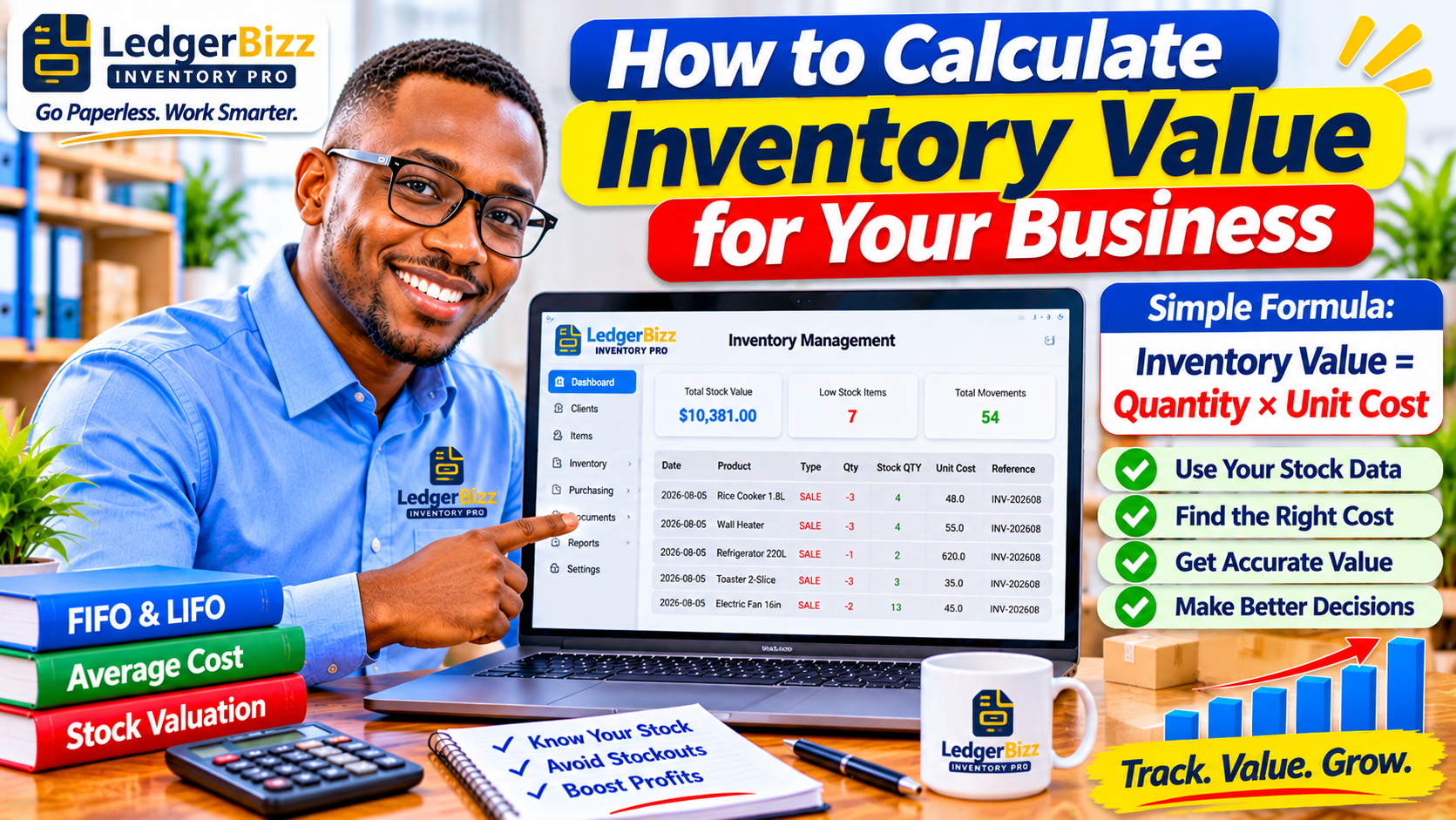
Stock is cash wearing a costume. Until you can say what your shelf is worth — and what it cost you — you cannot price properly, borrow credibly, or file accurately. The good news: with a movement-based system, inventory valuation is a by-product of doing business, not a separate project.
Here is how it works in LedgerBizz Inventory, with the math shown openly.
The Two Numbers That Matter #
- Stock Value — what your current inventory is worth at cost. The Dashboard and Inventory tab both show it as a live card, and Reports repeats it in the Stock Valuation sheet.
- Est. Profit — revenue minus the cost of what you sold (COGS). Knowing it per period tells you whether your margins are real or imagined.
Both derive from one discipline: recording the cost of every movement, not just the quantity.
Weighted Average Cost, Explained #
When you receive stock through a Purchase Order, the app recalculates the item's average cost from the new purchase price and the existing stock. That is Weighted Average Cost (WAC), and it smooths out price swings between suppliers.
A worked example:
| Event | Units | Unit cost | Result |
|---|---|---|---|
| Opening stock | 100 | $10.00 | 100 units @ $10.00 |
| PO received | 50 | $12.00 | 150 units @ $10.67 |
| Sale | 30 | — | 120 units @ $10.67 |
The new average: (100 × 10 + 50 × 12) ÷ 150 = $10.67. Every subsequent sale costs out at $10.67 until the next receipt changes the blend. You never touch a formula — Receive Stock does it.
Where the App Shows You the Truth #
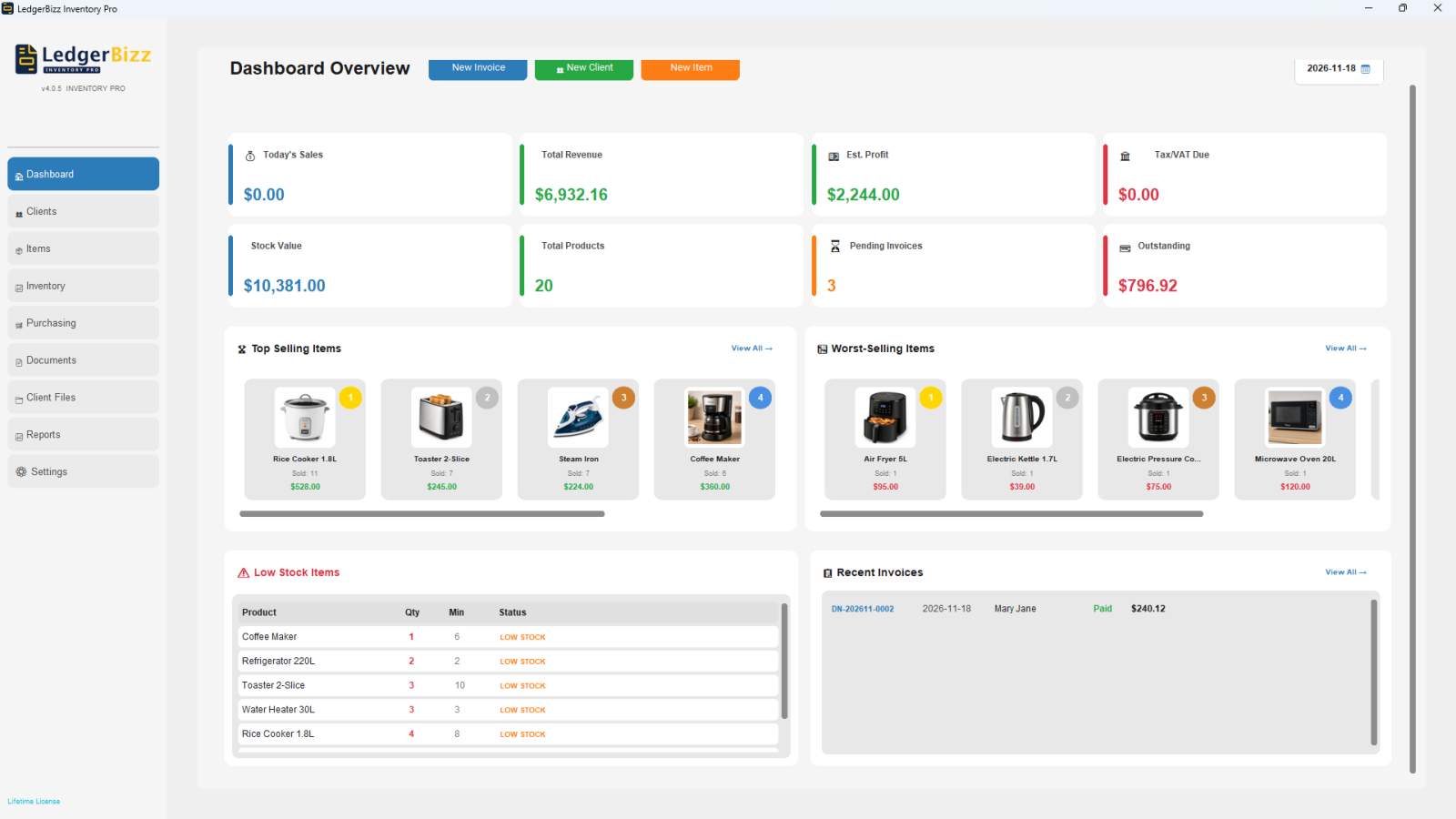
- Dashboard → Stock Value card: total units × current cost, live.
- Inventory tab → Total Stock Value card plus every movement's Unit Cost column.
- Reports → Export All: the Stock Valuation sheet (total items, units, value, low-stock count) and the Profit & Tax sheet (revenue, COGS, gross profit, tax liability).
- Reports → Est. Profit card: revenue excluding VAT minus COGS for the selected date range.
Because COGS comes from recorded costs rather than today's selling price, your profit figure survives supplier price changes and discounting.
Why Selling-Price Valuation Lies #
Valuing stock at selling price inflates your balance sheet with profit you have not earned yet. Valuing at the latest buying price ignores cheaper older stock. WAC sits honestly in between, which is why accountants accept it and why the app recalculates it on every receipt.
Three Habits That Keep Valuation Honest #
- Always receive through POs (or PURCHASE adjustments with a unit cost). A quantity without a cost is a hole in your valuation.
- Record damages at cost. The DAMAGE movement removes units and their cost together, so shrinkage shows up in profit instead of hiding in the shelf.
- Count and correct. After a stocktake, post ADJUSTMENT movements to target counts; the valuation follows automatically.
Using the Number #
- Pricing: if WAC creeps up and your selling price does not, margin is leaking — the buying/selling columns in the Items tab make the gap visible.
- Cash planning: Stock Value rising faster than sales means cash is turning into shelf furniture; slow-mover analysis tells you where.
- Insurance and credit: a dated Stock Valuation export is a defensible document, not a guess.
The Bottom Line #
Inventory value is not a spreadsheet you build once a year; it is a number your system maintains every day. The free trial of LedgerBizz Inventory computes WAC, Stock Value and COGS from your first receipt onward — receive one PO and watch the cards move.